

See how to make your business smarter with AI. Discover enterprise automation, ROI frameworks, and executive deployment strategies to scale in 2026.
How to make your business smarter with AI is no longer a question of experimenting with siloed productivity tools or isolated generative prompts; it has become the defining operational mandate for modern enterprise leadership. For C-suite executives, founders, and growth directors operating in an increasingly volatile digital landscape, intelligence is measured by systemic speed, predictive accuracy, and capital efficiency. Integrating cognitive technologies across core business units transforms static operations into self-optimizing ecosystems, positioning forward-thinking brands far ahead of competitors still anchored to legacy methodologies.
In 2026, artificial intelligence is not an IT novelty—it is a core balance-sheet driver. Moving beyond incremental workflow adjustments requires an executive blueprint that connects machine intelligence directly to customer lifetime value, market expansion, and enterprise valuation. To truly understand how to make your business smarter with AI, enterprise leaders must transition from asking what algorithms can generate to determining how machine intelligence can systematically eliminate operational friction and unearth high-margin revenue streams.
The 2026 Paradigm Shift: From Point Solutions to Unified Cognitive Architecture
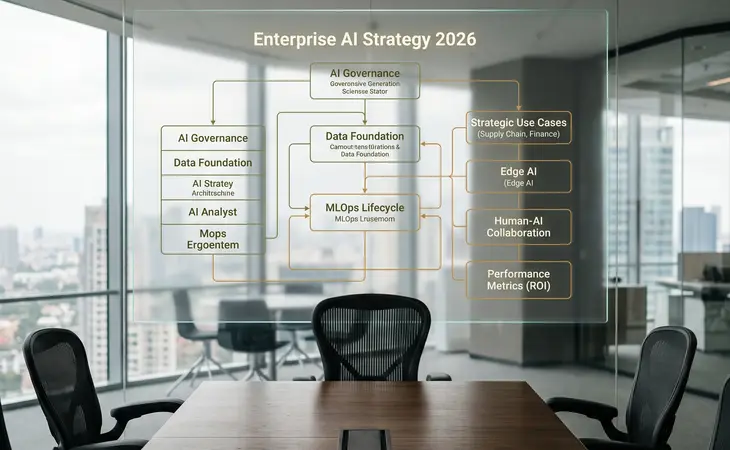
Over the past three years, the corporate landscape suffered from widespread tool fatigue. Enterprise teams rapidly adopted fragmented SaaS tools, resulting in disconnected data silos, governance vulnerabilities, and negligible EBITDA impact. The modern enterprise playbook demands unified cognitive architecture—a centralized operational fabric where data pipelines, predictive models, and autonomous agents cross-pollinate to drive strategic business decisions.
Achieving this level of organizational intelligence requires a fundamental redesign of information flow. Rather than deploying isolated chatbots for customer support or point software for automated reporting, enterprise leadership must anchor their transformation in centralized data lakes and cross-functional orchestration layers. When business intelligence becomes autonomous, strategic leadership gains real-time visibility into market shifts, supply chain anomalies, and customer sentiment before these variables impact quarterly earnings.
Moving Beyond Generative Novelty to Enterprise Value Creation
Generative text and visual tools introduced the market to artificial intelligence, but enterprise scale requires deterministic, high-accuracy intelligence. While generative models handle unstructured communication effectively, executive teams must couple them with predictive analytics, graph neural networks, and automated decision engines. This convergence allows organizations to anticipate client churn, dynamically price service contracts, and orchestrate complex market entry campaigns with mathematical precision.
Establishing Executive Alignment and Cognitive KPI Frameworks
An AI transformation fails when leadership treats it as a peripheral technology experiment rather than an enterprise-wide business transformation. Chief Executive Officers and Chief Marketing Officers must align around clear, quantifiable metrics:
- Revenue Velocity: Reducing sales cycle duration through real-time predictive lead qualification and behavioral scoring.
- Operational Margin Expansion: Eliminating manual cross-departmental handoffs by weaving deep integration into your broader Business Process Automation: 7 Executive ROI Strategies for 2026 framework.
- Predictive Accuracy: Increasing forecasting precision across inventory, pipeline conversion, and customer retention.
- Human Capital Leverage: Redirecting high-value intellectual capital from administrative synthesis toward strategic negotiation and high-tier client execution.

Ai & Automation
Explore our dedicated services, proven case studies, and tailored scopes.
Executive Strategy: How to Make Your Business Smarter with AI Across Core Operations
Knowing how to make your business smarter with AI requires identifying structural leverage points where machine learning generates compounding returns. Operations, RevOps, and digital presence represent the primary battlegrounds for enterprise efficiency.
Deploying autonomous intelligence across operational nodes enables companies to transition from reactive troubleshooting to proactive optimization. When algorithmic frameworks continuously ingest telemetry from sales pipelines, digital touchpoints, and client engagements, the organization begins functioning as a living, adaptive entity.
Streamlining Operational RevOps and Sales Pipeline Intelligence
Modern revenue operations cannot rely on quarterly pipeline reviews and subjective sales rep feedback. Advanced AI engines ingest millions of interaction signals—from email sentiment and meeting transcription nuance to digital footprint touchpoints—to predict deal close rates with remarkable accuracy. By surfacing invisible deal risks before pipeline slippage occurs, revenue leaders can reallocate executive deal support and technical resources dynamically.
Furthermore, automated lead scoring models eliminate manual qualification bottlenecks. Instead of treating all inbound prospect data uniformly, machine learning models cross-reference incoming data against historical win/loss parameters, identifying high-intent accounts and routing them instantly to senior client partners with custom-tailored battlecards.
Auditing and Upgrading Digital Infrastructure for Cognitive Readiness
An intelligent enterprise cannot thrive on a broken digital foundation. If your customer-facing platforms, enterprise portals, or conversion funnels suffer from technical friction, cognitive algorithms will merely accelerate operational inefficiencies. Executive teams must perform rigorous technical audits, such as Fixing Website Issues: 7 Costly SEO Gaps Hurting Revenue, ensuring that data pipelines, tracking schemas, and underlying digital architectures are completely robust before overlaying sophisticated predictive tooling.
Predictive Analytics and Precision Decision-Making for C-Level Leadership
The primary advantage of enterprise AI lies in the mitigation of uncertainty. In traditional corporate frameworks, strategic decisions rely heavily on backward-looking reporting—lagging indicators that reveal what occurred last month or last quarter. Predictive intelligence transforms enterprise governance into an anticipatory science.
By leveraging statistical modeling and deep learning algorithms against historical business data and macroeconomic market signals, leadership teams can simulate strategic scenarios before allocating millions in capital. Whether evaluating a cross-border expansion, an M&A target, or a new product line, machine learning simulations provide probabilistic confidence intervals that dramatically de-risk executive choices.
Capital Allocation and Scenario Modeling
Strategic resource allocation has historically been constrained by human processing limits. Modern machine learning models allow CFOs and executive strategists to stress-test financial resilience against hundreds of market variables simultaneously. Algorithmic modeling uncovers non-linear relationships between marketing spend, digital conversion velocities, and customer retention, ensuring capital is deployed strictly where marginal return is maximized.
Supply Chain and Resource Optimization
For enterprise firms managing physical assets, digital services, or distributed talent pools, predictive resource balancing prevents costly operational overages and capacity bottlenecks. Machine learning platforms analyze real-time consumption trends, historical project burn rates, and market availability to reallocate human and technical infrastructure dynamically, maintaining target margin thresholds without sacrificing delivery quality.

Business Process Automation: 7 Executive ROI Strategies for 2026
Revamping Customer Experience and Market Intelligence
Client expectations have shifted permanently toward instant, hyper-personalized engagement. Standard response times that were acceptable two years ago are now immediate indicators of corporate stagnation. Implementing cognitive customer experience architecture allows organizations to deliver bespoke, context-aware interactions at enterprise scale.
Building real-time intelligence into your front-office operations creates an enduring moat. As discussed in industry analyses on enterprise AI strategy, empowerment, and adaptability, long-term market dominance belongs to organizations that utilize algorithmic insights to foster customer trust rather than simply automating cold interactions.
Hyper-Personalized B2B Client Journeys
In the enterprise B2B arena, client decision-makers interact with dozens of digital assets before engaging with an executive partner. Intelligent personalization engines analyze firmographic data, on-site consumption habits, and organizational pain points to serve customized case studies, dynamic solution scopes, and personalized landing experiences in real time. This micro-tailored engagement positions your firm as an intuitive partner from the very first impression.
Sentiment Telemetry and Proactive Churn Prevention
Retaining high-value enterprise accounts requires continuous health monitoring. Natural Language Processing (NLP) models integrated with client communications, support ticketing architectures, and operational deliverables monitor relationship sentiment over time. When algorithmic markers detect subtle shifts in client tone or engagement frequency, account leadership receives automated escalations, enabling swift strategic intervention before contract renewal periods.
Designing an Agency-Led AI Marketing and Acquisition Engine
Scaling digital acquisition in an algorithmic era requires sophisticated execution that blends creative excellence with computational rigor. Modern brand building is no longer about isolated campaign bursts; it is about deploying continuous, data-driven growth loops that self-optimize through machine learning.
Executive leaders must evaluate whether their internal teams possess the specialized data engineering and creative modeling capabilities required to operate these systems. Collaborating with specialized growth agencies ensures your marketing engine incorporates elite strategic frameworks without inflating internal corporate overhead or slowing time-to-market.
Scalable Organic Growth and Content Intelligence
Search algorithms in 2026 evaluate content not merely on keyword density, but on deep informational density, topical authority, and semantic intent. To maintain visibility, market leaders deploy cognitive content intelligence systems that map enterprise search ecosystems, identify unmet buyer intent, and orchestrate comprehensive editorial roadmaps. Exploring advanced AI B2B marketing tools and strategies highlights how high-growth firms systematically integrate machine intelligence into customer acquisition funnels to outperform entrenched legacy competitors.
Dynamic Creative Optimization and Precision Attribution
Paid media acquisition across executive networks requires dynamic creative iteration. Machine learning systems analyze thousands of visual variables, value propositions, and positioning frameworks against distinct C-level buyer personas, autonomously refining ad distribution to yield the lowest customer acquisition cost (CAC). Coupled with multi-touch algorithmic attribution models, CMOs gain transparent reporting on which marketing initiatives directly impact multi-million-dollar pipelines.

Fixing Website Issues: 7 Costly SEO Gaps Hurting Revenue
Strategic Implementation: How to Make Your Business Smarter with AI Through Outsourcing
A primary failure mode for enterprise executives is attempting to build complex artificial intelligence stacks entirely in-house from scratch. Data engineering talent is exceptionally scarce, model development cycles are prolonged, and initial research and development investments often stall without delivering visible ROI. Strategic outsourcing presents a far more capital-efficient path to market leadership.
Partnering with a specialized strategic agency allows enterprises to bypass years of technical trial and error. Expert digital growth agencies bring battle-tested architectural blueprints, proprietary workflow integrations, and immediate access to top-tier machine learning talent, compressing digital transformation timelines from years into quarters.
| Evaluation Dimension | Internal In-House Build | Specialized Agency Partnership |
|---|---|---|
| Time to Market | 12 to 18 Months (Hiring + R&D) | 4 to 8 Weeks (Ready Architectures) |
| Capital Expenditure | High Fixed Payroll & Infrastructure | Predictable Retainer / Milestone-Based |
| Technology Obsolescence Risk | High (Internal teams maintain legacy tech) | Low (Agencies continuously upgrade stacks) |
| Cross-Industry Best Practices | Isolated to internal historical data | Informed by broad enterprise market data |
Evaluating Strategic Growth Agencies for AI Readiness
When selecting an enterprise partner to guide how to make your business smarter with AI, leadership must conduct rigorous technical due diligence. Do not settle for agencies that merely layer standard ChatGPT API wrappers over outdated marketing deliverables. Look for agencies that demonstrate:
- Full-Stack Architectural Competence: Mastery over data ingestion pipelines, vector databases, custom integration middleware, and deterministic analytical systems.
- Commercial Focus: An explicit orientation toward EBITDA expansion, pipeline velocity, and measurable operational savings over vanity engagement metrics.
- Data Governance and Security Safeguards: Robust contractual protocols ensuring proprietary client data is never leaked into public foundational training sets.
- Change Enablement Playbooks: Comprehensive onboarding strategies that upskill internal leadership and staff to ensure sustainable software adoption.
Risk Mitigation, Data Governance, and Ethical AI Stewardship
Accelerating machine intelligence without robust enterprise governance introduces substantial regulatory, intellectual property, and reputational hazards. In 2026, corporate boards and compliance officers require ironclad assurance that autonomous systems adhere strictly to global data protection laws, algorithmic transparency mandates, and enterprise-grade privacy controls.
Implementing an intelligent business architecture requires an active, multi-layered risk mitigation protocol. Leaders must establish clear boundaries regarding data usage, automated execution thresholds, and model explainability.
Protecting Proprietary Enterprise Data and Intellectual Property
The primary asset of any high-performing firm is its proprietary data moat—trade secrets, custom client contracts, proprietary operational workflows, and private transaction records. When choosing cognitive platforms or agency partners, executives must mandate enterprise-level zero-data-retention agreements and isolated virtual private cloud (VPC) deployments. Client intelligence and operational data must remain strictly isolated within dedicated enterprise perimeters.
Establishing Human-in-the-Loop Safeguards for Critical Decisions
While algorithmic execution optimizes low-risk operational workflows autonomously, critical high-impact decisions must retain human-in-the-loop (HITL) checkpoints. Whether issuing high-value commercial proposals, implementing broad organizational restructuring, or approving major strategic messaging, machine learning must act as an augmentative intelligence engine rather than an unmonitored decision-maker.
Executive Roadmap: Transitioning Your Enterprise into an Intelligent Leader
Transforming your organization into an intelligent, data-driven enterprise is an iterative, milestone-driven journey that demands disciplined executive leadership. Organizations that attempt monolithic, overnight overhauls routinely encounter cultural resistance and operational paralysis.
A structured 90-day onboarding blueprint ensures immediate operational victories while building the long-term foundation for total digital dominance.
Phase 1: Operational Diagnostic and Data Audit (Days 1–30)
Identify the top three operational friction points where manual handoffs and data fragmentation degrade margins. Audit current data hygiene, tracking instrumentation, and digital assets. Establish baseline metrics for pipeline velocity, client retention, and cost-per-acquisition.
Phase 2: Architectural Integration and Agency Pilot (Days 31–60)
Partner with an elite digital growth agency to deploy centralized data workflows and launch high-impact predictive models within your most critical revenue channels. Implement automated RevOps workflows, predictive lead scoring, and algorithmic content intelligence systems.
Phase 3: Cross-Functional Scaling and Governance (Days 61–90+)
Expand cognitive workflows across peripheral departments, including client success, talent management, and financial modeling. Formalize continuous optimization cadences with your agency partners and conduct quarterly executive audits to measure balance-sheet ROI and margin expansion.
Claiming Your Competitive Advantage Through Intelligent Transformation
The transition toward an autonomous, highly intelligent enterprise is not a future prospect—it is the present operational reality dividing industry champions from legacy casualties. Understanding precisely how to make your business smarter with AI allows executive leaders to build organizations that learn continuously, execute flawlessly, and adapt instantly to turbulent market shifts.
By bypassing the pitfalls of disjointed internal experiments and anchoring your transformation in proven agency expertise, modern infrastructure, and uncompromising governance, you secure an unassailable strategic moat. The executive mandate for 2026 is unambiguous: align your leadership team, modernize your operational architecture, and let predictive intelligence drive your next decade of compounding enterprise value.
Frequently Asked Questions
What differentiates a unified cognitive architecture from traditional AI point solutions?
Traditional AI adoption relied on fragmented SaaS tools and isolated generative prompts, resulting in data silos and minimal EBITDA impact. A unified cognitive architecture integrates centralized data pipelines, predictive analytics, and autonomous decision engines across all business units to drive measurable operational speed, revenue velocity, and enterprise valuation.
Why is partnering with a specialized agency more capital-efficient than building an in-house AI stack?
Developing custom enterprise AI internally requires scarce engineering talent, heavy capital expenditure, and typically takes 12 to 18 months. Specialized growth agencies provide proven architectural blueprints, immediate access to machine learning experts, and reduced technology obsolescence risk, compressing time-to-market down to 4 to 8 weeks.
How does predictive AI de-risk strategic capital allocation for C-level leadership?
Rather than relying on lagging historical reports, predictive models simulate complex market, financial, and operational scenarios against hundreds of variables simultaneously. This gives leadership probabilistic confidence intervals to forecast pipeline performance, optimize supply chains, and deploy capital where marginal returns are maximized.
What data governance safeguards are required when implementing enterprise-level AI?
Enterprises must enforce strict zero-data-retention agreements, mandate isolated Virtual Private Cloud (VPC) deployments to prevent proprietary data leakage into public training sets, and embed human-in-the-loop (HITL) checkpoints for mission-critical, high-impact decisions.
Transform Your Workflows with Intelligent AI & Automation
Stop losing hours to manual operations and start scaling your bottom line with enterprise-grade AI solutions tailored to your business model. Partner with HGR to deploy high-impact automation pipelines that cut overhead and drive measurable ROI.