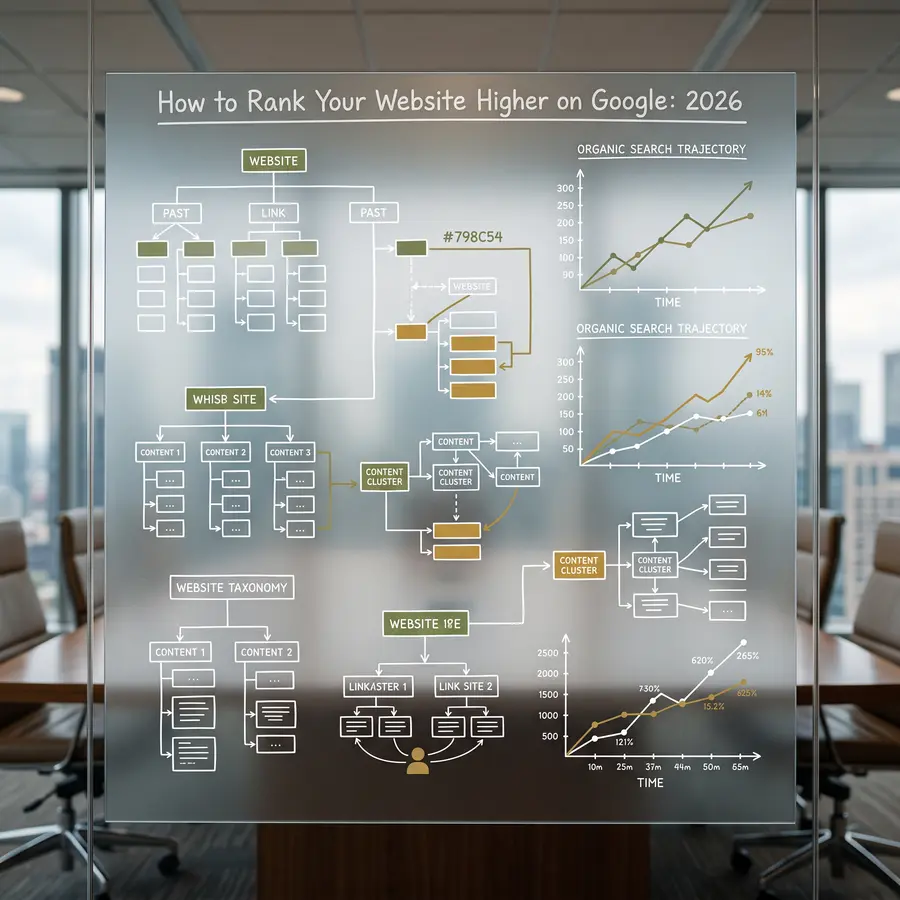

Master how to rank your website higher on Google in 2026. Discover enterprise SEO frameworks to scale pipeline, lead search share, and drive maximum ROI.
How to rank your website higher on Google in 2026 demands a fundamental departure from legacy keyword mechanics, shifting instead toward an integrated model of topical dominance, technical resilience, and digital brand equity. For executive leadership—Chief Marketing Officers, Chief Growth Officers, and enterprise founders—organic search is no longer an isolated technical experiment conducted in a marketing silo. It is a core capital asset that directly impacts enterprise valuation, lowers customer acquisition costs (CAC), and establishes defensible market moats. As Google’s machine-learning algorithms and multimodal generative engines continuously recalibrate how commercial intent is parsed, high-performing organizations must align their corporate digital footprint with sophisticated retrieval-augmented generation (RAG) ecosystems and search intent nuances.
Achieving premier organic positioning requires viewing search through the lens of executive governance. Search visibility is an ongoing operational commitment that demands cross-functional orchestration among software engineering, brand PR, product marketing, and senior leadership. Leaders examining the 2026 Enterprise SEO Framework recognize that visibility is dictated not by the volume of content generated, but by the strategic precision of information architecture, technical agility, and unassailable digital provenance.
The Executive Paradigm: Search Engine Visibility in 2026

Modern search engines operate as predictive discovery engines rather than basic document retrieval networks. Algorithms evaluate organizational web properties based on real-time user satisfaction, verifiable institutional credentials, and semantic depth. When leadership teams evaluate how organic search fits into the broader enterprise growth thesis, understanding how to rank your website higher on Google requires viewing search engines as sophisticated enterprise partners evaluating your firm’s industry standing and digital reliability.
Moving Beyond Tactical SEO: Organic Search as a Revenue Engine
Historically, SEO was relegated to tactical practitioners focused on metadata manipulation, keyword stuffing, and manual backlink farming. In the contemporary digital economy, organic search functions as an authoritative distribution vehicle that drives commercial pipeline. A top-tier ranking for high-intent institutional search queries commands immediate executive trust, capturing prospective clients at the precise moment their business problem requires resolution. When deployed with institutional rigor, organic performance yields an evergreen stream of qualified enterprise inquiries, insulating the organization against the margin volatility of programmatic and paid media networks.
Generative Engine Optimization (GEO) vs. Traditional Algorithmic Indexing
The convergence of Google’s Search Generative Experience (SGE) and traditional algorithmic SERPs has fundamentally altered the path to organic conversion. Modern web indexing systems extract answers directly from authoritative corporate assets to synthesize immediate generative overviews. To maintain brand visibility in this hybrid landscape, enterprise content must be engineered for machine parseability and semantic clarity. Organizations must structure their domain assets so that search crawlers extract verified corporate facts, proprietary data sets, and definitive industry insights, ensuring your brand serves as the primary cited source in both conversational AI interfaces and traditional search rankings.

Seo
Explore our dedicated services, proven case studies, and tailored scopes.
Architectural Foundations: Technical Resilience and Web Operations
An enterprise digital architecture must be built to withstand the rigors of modern web scraping, rapid rendering, and deep crawler discovery. For complex corporate platforms managing tens of thousands of dynamic URLs, technical debt is the silent killer of organic market share. Without a pristine technical foundation, even the most sophisticated brand communications and thought leadership assets will fail to achieve indexation and ranking visibility.
Modern Core Web Vitals and Headless CMS Architectures
Google’s Core Web Vitals—focusing on Interaction to Next Paint (INP), Largest Contentful Paint (LCP), and Cumulative Layout Shift (CLS)—serve as absolute baselines for organic competitiveness. High-growth enterprises utilizing headless content management systems (such as Contentful, Sanity, or custom Next.js integrations) must balance engineering agility with algorithmic crawlability. When enterprise portals suffer from bloated JavaScript payloads or third-party tracking scripts, render performance degrades, triggering crawler drop-offs and algorithmic ranking suppression.
- Client-Side Rendering (CSR) Vulnerabilities: Relying purely on client-side JavaScript risks incomplete indexation by search bots running on rendering timeouts. Enterprise architectures should prioritize Server-Side Rendering (SSR) or Static Site Generation (SSG).
- Asset Delivery Optimization: Global enterprises must deploy modern Content Delivery Networks (CDNs) configured for edge caching, HTTP/3 delivery, and dynamic image compression to preserve sub-second server response times.
- Script Governance: Corporate marketing teams must implement strict tagging governance to eliminate redundant tracking tags that dilute DOM performance and compromise INP scores.
Crawl Budget Optimization for Enterprise Footprints
Crawl budget—the volume of URLs search engines allocate computing power to crawl on a specific site within a given timeframe—is finite. Large-scale web properties, particularly B2B platforms featuring extensive knowledge bases, customer portals, and dynamic service directories, frequently waste crawl budget on low-value pages. Implementing robust server-side directives, meticulous XML sitemap hierarchies, and tactical canonical tags ensures search engine spiders spend resources indexing high-intent, revenue-generating commercial landing pages.
Semantic Authority Engineering: Dominating Topical Ecosystems
Google has transitioned entirely from exact-match keyword indexing to entity-based understanding. The search engine understands real-world entities—companies, executives, technologies, and methodologies—and evaluates the relationships between them. Consequently, capturing high-value rankings requires dominating an entire topical ecosystem through structured semantic depth rather than producing disconnected content pieces.
How to Rank Your Website Higher on Google Through Information Architecture
To establish institutional relevance, enterprise web architecture must organize knowledge into distinct, authoritative topical clusters. Mastering how to rank your website higher on Google through information architecture requires building centralized “pillar” environments that unpack core enterprise competencies, supported by contextually linked subordinate pages that address granular executive considerations. This interlinking architecture clearly signals to algorithmic systems that your organization possesses comprehensive subject-matter mastery across the entire vertical.
For high-growth software and service enterprises, analyzing rigorous B2B SaaS SEO strategic frameworks illustrates how structural siloing prevents internal page cannibalization while accelerating topical indexing across enterprise-level product offerings.
E-E-A-T and First-Party Enterprise Data Integration
Google’s quality assessment frameworks heavily weigh Experience, Expertise, Authoritativeness, and Trustworthiness (E-E-A-T), particularly for commercial and technical verticals where accuracy is paramount. Autonomous AI-generated content has saturated search indexes with generic, low-value summaries. Consequently, search algorithms explicitly elevate platforms that offer first-party proprietary data, original corporate research, and verified executive perspectives.
- Verified Executive Byline Attribution: Content must be authored or systematically validated by credentialed domain experts, backed by complete schema markup linking to external industry citations.
- Proprietary Research & Benchmarks: Publishing original enterprise data reports, transactional benchmark analyses, and peer-reviewed whitepapers creates an unassailable digital footprint that algorithms actively identify as a primary source.
- Organizational Trust Signals: Prominently displayed enterprise security certifications, compliance protocols (SOC2, ISO), and verified corporate registrations reinforce your domain’s credibility matrix.

Rank #1 on Google: The 2026 Enterprise SEO Framework
Board-Level Blueprint: How to Rank Your Website Higher on Google at Scale
Scaling organic performance across a multi-business-unit enterprise requires structural discipline. Corporate initiatives cannot rely on uncoordinated marketing sprints. Instead, leadership must institute a formal operational model that integrates search visibility objectives into daily engineering cycles, corporate communications, and product releases.
Cross-Functional Alignment: Product, Engineering, and Marketing
The most common cause of organic growth stagnation in large organizations is operational fragmentation. Web development teams deploy platform updates that inadvertently strip essential schema data; the brand communications team publishes press assets on external microsites rather than capturing equity on the primary domain; and product marketers introduce unvetted nomenclature that bypasses actual buyer search patterns. Modern executive leadership addresses this by embedding an organic growth gatekeeper into the product and software development lifecycles (SDLC).
When engineering sprints directly incorporate search health acceptance criteria, platform migrations and redesigns preserve historical domain equity without suffering catastrophic organic traffic collapses.
Resource Allocation and Capital Efficiency
Enterprise organic search strategy is not an expense line item; it is a strategic investment in compounding customer acquisition efficiency. While paid digital acquisition channels scale linearly—where each prospective lead requires continuous media spend—organic visibility compounds. A top-ranking positioning asset created and optimized today continues to harvest high-intent market demand over multiple quarters or years without recurring media fees, fundamentally improving operating margins and enterprise EBITDA.
Enterprise Link Equity Acquisition and Brand Mentions
While on-page architecture and topical breadth establish relevance, authoritative external references remain the foundational currency of search engine trust. Google’s PageRank algorithm, though evolved into a complex machine-learning ensemble, still requires off-page verification to validate a web property’s authority.
Digital PR and Industry Authority Acquisition
Modern link acquisition for enterprise platforms has discarded manual web directory submissions and tactical outreach in favor of strategic Digital Public Relations. High-value backlinks must originate from established institutional news organizations, recognized academic institutions, and top-tier trade publications. Discovering how to rank your website higher on Google without relying on synthetic link networks requires deploying authoritative thought leadership campaigns that journalists, industry analysts, and market researchers naturally cite as definitive reference points.
Insights shared in contemporary enterprise discussions on modern search algorithms highlight that unlinked brand mentions in reputable industry media are increasingly indexed by search systems as ambient authority signals, further validating a domain’s off-page standing.
Mitigating Algorithmic Penalties and Link Toxicity
Large web properties inevitably accumulate anomalous inbound link profiles over time. Negative SEO campaigns, automated scraper networks, and residual links from historical marketing agencies can introduce risk. Executive governance demands regular link graph audits to identify and neutralize toxic backlink clusters. By maintaining a clean, defensible backlink profile, leadership safeguards the enterprise against punitive algorithmic updates that can wipe out organic pipeline overnight.

Enterprise Website SEO Services: 2026 Executive ROI Guide
Converting Organic Footprint into Enterprise Pipeline
Securing first-page visibility is useless if that traffic does not systematically convert into qualified business relationships. An executive search strategy measures success not through vanity impression metrics, but through qualified enterprise pipeline velocity and attributable revenue contribution.
Optimizing for High-Intent B2B Decision Makers
Enterprise procurement pathways are long, complex, and involve multi-stakeholder buying committees. Web properties must align content experiences to specific decision-maker personas at discrete evaluation stages. While informational search queries build market awareness, commercial-investigation and transactional queries represent immediate pipeline opportunities.
- Commercial Comparison Hubs: Develop authoritative, objective comparison frameworks that analyze enterprise solutions, openly outlining functional capabilities, integration requirements, and architectural trade-offs.
- Executive Briefings and Solution Blueprints: Replace generic lead magnets with comprehensive technical documentation, integration guides, and regulatory compliance matrices that validate product capability to enterprise gatekeepers.
- Frictionless Conversion Gateways: Remove excessive form fields and replace them with modern, progressive profiling or self-selection pathways tailored for VP- and C-suite visitors.
Multi-Touch Attribution and Search-Assisted Revenue
Because enterprise sales cycles frequently span six to eighteen months, first-click or last-click attribution models fail to capture the true commercial impact of organic search. Implementing sophisticated multi-touch attribution (MTA) frameworks reveals the role organic search plays across mid-funnel validation and post-demo due diligence. When evaluating enterprise-level performance, leaders should consult the Enterprise Website SEO Services: 2026 Executive ROI Guide to establish definitive financial models that link organic positioning directly to bottom-line enterprise value creation.
Agency Partnership vs. In-House Capabilities: The Outsourcing Matrix
A pressing operational dilemma for CMOs and enterprise leaders is determining whether to build an internal organic search apparatus or retain an elite external growth advisory. Both models present distinct capital and governance implications.
Evaluating Specialized Enterprise Growth Agencies
While an in-house team understands internal corporate politics and core product mechanics, they often operate in an echo chamber, insulated from rapid algorithmic shifts occurring across broader digital markets. Specialized external agencies bring cross-industry intelligence, immediate technical capabilities, proprietary tool stacks, and pre-established media relationships. When selecting an agency partner, executive teams should evaluate firms based on technical engineering depth, enterprise governance acumen, and verified case histories of scaling organic pipeline for complex business operations.
Enterprise stakeholders determining how to rank your website higher on Google consistently realize that a hybrid operational model yields optimal results: an internal strategic lead coordinating with an elite external agency execution team capable of deploying specialized technical, editorial, and PR campaigns at velocity.
Governance Frameworks and SLA Benchmarking
To avoid misaligned agency engagements, contracts must move beyond vanity deliverables like “articles written” or “links built.” High-impact partnerships establish Service Level Agreements (SLAs) anchored in technical health resolution times, organic market share growth across high-intent topic clusters, and traceable pipeline generation. Clear accountability frameworks protect organizational capital while ensuring transparent operational velocity.
Risk Management: Protecting Market Share Against Search Volatility
Market leaders must continuously defend their established search real estate against algorithmic disruption and dynamic competitive maneuvers. Proactive risk management prevents painful enterprise traffic degradation that jeopardizes quarterly revenue projections.
Core Update Survival Protocols and Technical Audits
Google rolls out major core algorithm updates multiple times each year. These systemic updates recalibrate quality thresholds across the global web. Organizations that suffer severe ranking drops during these updates rarely experience a single catastrophic technical failure; rather, their websites exhibit a compounding accumulation of low-quality pages, out-of-date technical structures, and diluted entity relevance. Implementing quarterly technical resilience audits ensures your digital infrastructure continuously adheres to Google’s evolving quality benchmarks.
Countering AI Answer Scrapers and Zero-Click Erosion
As search engines display increasingly direct answers within search results, zero-click searches have risen. Enterprises must adapt their content strategy to address this paradigm. While basic factual queries are increasingly answered directly in the SERP, complex enterprise problems—such as regulatory compliance, enterprise software integration, and organizational change management—defy simple one-paragraph summaries. By focusing corporate thought leadership on nuanced, multi-variable business challenges, organizations protect their web assets against zero-click traffic erosion.
Strategic Implementation Roadmap: Executing the 2026 Search Mandate
Transitioning from an ad-hoc search approach to an institutional growth engine requires a disciplined execution roadmap. Strategic transformation requires methodical, phased operational gates that deliver measurable improvements at every step of deployment.
Phase-Gate Milestones for Q1-Q4 Deployment
The enterprise growth plan begins with a comprehensive technical remediation and entity audit during the initial 60 days. This phase focuses entirely on eliminating crawl bottlenecks, resolving rendering inefficiencies, and standardizing entity schema markup across all domain assets. Following technical stabilization, the organization shifts resources toward content ecosystem realignment: auditing legacy libraries, consolidating redundant pages, and engineering comprehensive topical hubs. The final operational phases scale digital PR initiatives and refine conversion optimization across validated organic landing pages.
Executing the multi-quarter roadmap for how to rank your website higher on Google centers on phased governance, ensuring operational investments are validated against measurable technical performance and lead-generation metrics before capital is committed to the next phase.
Executive KPI Dashboards and Velocity Metrics
To maintain corporate visibility, leadership requires clean, uncluttered reporting dashboards that abstract technical minutiae into clear executive indicators. Effective board-level search reporting tracks four vital health signals:
- Topical Market Share: The percentage of high-intent, industry-defining queries your domain controls relative to primary market competitors.
- Technical Infrastructure Health: Real-time Core Web Vitals compliance scores, crawl error rates, and average indexation latency for newly published platform pages.
- Organic Pipeline Attribution: Multi-touch pipeline velocity, organic-assisted contract values, and qualified enterprise sales opportunities originated via search.
- Brand Entity Prominence: Measurable expansion of verified brand search volume and algorithmic citation frequency across generative search answers.
By treating search engine visibility as an enterprise capability rather than an isolated tactical campaign, forward-thinking organizations capture unmatched digital authority. In 2026 and beyond, market leadership belongs to enterprises that combine technical precision, semantic authority, and disciplined organizational execution to dominate the search landscape.
Frequently Asked Questions
How does Generative Engine Optimization (GEO) alter enterprise search strategy in 2026?
GEO shifts performance metrics from keyword rankings to establishing your organization as the primary cited source within AI-synthesized overviews. To maintain brand visibility in hybrid search results, enterprise assets must be structured for machine parseability using verified entity schemas, first-party research, and semantic topical depth that algorithms naturally cite.
Why is client-side rendering in headless CMS platforms a risk for enterprise organic growth?
Relying strictly on client-side rendering (CSR) introduces rendering timeouts that prevent search crawlers from fully discovering and indexing dynamic URLs. Enterprise platforms should deploy server-side rendering (SSR) or static site generation (SSG) alongside strict script governance to safeguard crawl budget and ensure optimal Interaction to Next Paint (INP) scores.
How can organizations insulate their organic market share from zero-click search erosion?
Enterprises must transition their editorial focus away from elementary factual queries that AI engines easily summarize. Defensible visibility is achieved by producing nuanced, multi-variable analyses, such as proprietary benchmarks, regulatory integration frameworks, and complex organizational case studies that demand authoritative, primary-source exploration.
What is the optimal operational model between an in-house SEO apparatus and an external agency?
A hybrid model maximizes enterprise capital efficiency. An internal strategic growth lead ensures cross-functional governance across software engineering sprints, brand PR, and product marketing, while a specialized external agency provides cross-market algorithmic intelligence, technical remediation depth, and high-velocity digital PR execution.
Scale Your Organic Pipeline with Enterprise-Grade SEO
Algorithm shifts shouldn’t compromise your market share or predictable revenue pipeline. Partner with HGR to deploy an aggressive, data-driven SEO roadmap that captures high-intent search demand and drives measurable ROI.